TOWN OF KORTRIGHT CDBG PUBLIC HEARING
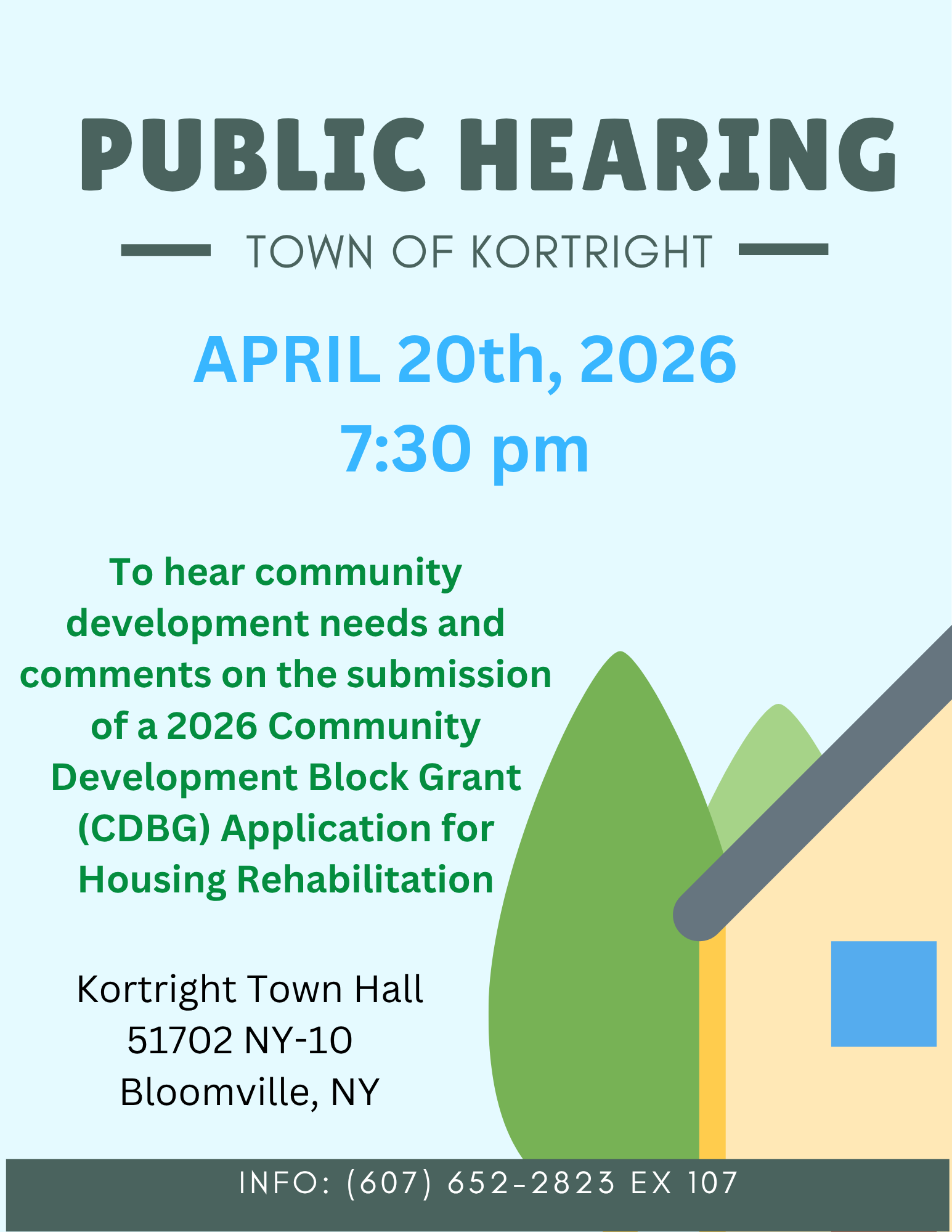
In addition to any other business that may come before it, the Kortright Town Board will hold a public hearing on April 20, 2026 at 7:30 pm at the Kortright Town Hall, 51702 NY-10, Bloomville, NY 13739 for the purpose of hearing public comments on Kortright’s community development needs, and to discuss the submission of a Community Development Block Grant (CDBG) application for the 2026 program year. The CDBG program is administered by the New York State Office of Community Renewal (OCR) and will make available to eligible local governments approximately $17 million for the 2026 program year for housing, economic development, public facilities, public infrastructure, and planning activities, with the principal purpose of benefitting low/moderate income persons. The Town of Kortright is applying for up to $500,000 in CDBG funds for single family housing rehabilitation. The hearing will provide further information about the CDBG program and will allow for citizen participation in the development of any proposed grant applications and/or to provide technical assistance to develop alternate proposals. Comments on the CDBG program or proposed project will be received at this time. The hearing is being conducted pursuant to Section 570.486, Subpart I of the CFR and in compliance with the requirements of the Housing and Community Development Act of 1974, as amended.
The Kortright Town Hall is accessible to persons with disabilities. If special accommodations are needed for persons with disabilities, those with hearing impairments, or those in need of translation from English, those individuals should contact Kristin Craft, Town Clerk, at 607-538-9313 at least one week in advance of the hearing date to allow for necessary arrangements. Written comments may also be submitted to Kristin Craft, Town Clerk, 51702 NY-10, Bloomville, NY 13739 or brought to the meeting. The last date to receive comments is April 24, 2026.
Town of Kortright 2026 CDBG Housing Rehabilitation Program Public Hearing Agenda
The purpose of this public hearing is to hear public comments on the Town of Kortright’s community development needs, and to discuss the submission of a Community Development Block Grant (CDBG) application for the 2026 program year. The hearing allows for citizen participation in the development of any proposed grant applications and/or to provide technical assistance to develop alternate proposals.
The CDBG program is administered by the New York State Office of Community Renewal (OCR) and will make available to eligible local governments approximately $17 million for the 2026 program year for housing, economic development, public facilities, public infrastructure, and planning activities, with the principal purpose of benefitting low/moderate income persons.
The Town of Kortright is applying for $500,000 in CDBG funds for housing rehabilitation for its residents. Western Catskills Community Revitalization Council, a not-for-profit rural preservation company, will act as subrecipient and administer the program if the grant is awarded.
The amount of CDBG funds expected to be made available is $500,000 over the two years of the program. This is $410,000 for construction, $65,000 in program delivery included required environmental testing, and $25,000 in administration. These funds will be made available to low to moderate income households whose income is up to 80% of the county median income. The full construction amount of CDBG funds proposed for activities will benefit LMI National Objectives.
The proposed CDBG activities do not expect to result in displacement. However, if displacement is necessary it will conform to the municipality’s anti-displacement and relocation plan required under 24 CFR 570.488.
The activities to be undertaken with CDBG funds are housing rehabilitation for repair of health and safety issues. Repairs will follow HUD guidelines for priority of items which include, but are not limited to the following:
Priority One Items: Health and Safety Improvements
- HUD Section 8 Standards – all work items necessary to bring the building into compliance with HUD Section 8 Housing Quality Standards.
- Codes – work items required to comply with New York State Uniform Fire Prevention Code, New York State Building Code and local codes.
- Roof – repair or replacement (if life expectancy is less than 3 years).
- Plumbing Systems – any work necessary to comply with the New York State Uniform Fire Protection and Building Code.
- Electrical Wiring – any work necessary to comply with Section 8 Existing Housing Quality Standards.
- Heating Systems – installation or upgrading of heating systems to maintain an interior temperature of at least 68 degrees F.
- Structural – repair or replacement of any structural defects, such as settling of porches, foundations, rotted support columns, rotted subflooring, masonry, etc.
- Lead Paint – reduction of lead-based paint hazards.
- Windows – replacement or repair of broken sash or panes.
- Doors – replacement or repair of damaged primary doors.
- Stairwells and Platforms – any work necessary to ensure that they are safe.
Priority Two Items: Energy Related Improvements
The following energy conservation and weatherization items are eligible.
- Windows – repair or installation of storm or insulated glass windows.
- Doors – repair or installation of storm or more energy efficient doors.
- Insulation – installation of ceiling, wall, floor, and foundation insulation with proper ventilation.
- Caulking and Weather Stripping – repair or installation of caulking and weather-stripping materials.
- Water Heater Insulation – repair or installation of water heater insulation.
Priority Three Items: Other Necessary Improvements
The following list of items are eligible for assistance only if all conditions which may lead to health and safety problems (listed above) and energy conservation and weatherization items (listed above) are being corrected, or if none exist. The following would be considered Priority Three items; not listed in order of importance:
- Exterior Protection – painting or covering of exterior surfaces, except that existing wood siding shall not be covered, unless no feasible alternative exists.
- Wood Surfaces – repair of any damaged or deteriorated wood surfaces.
- Interior Walls and Ceilings – repair of covering of interior walls and ceilings. Use of vapor barrier paints is encouraged.
- Floor – covering of floors.
Public hearing will be open to questions and comments